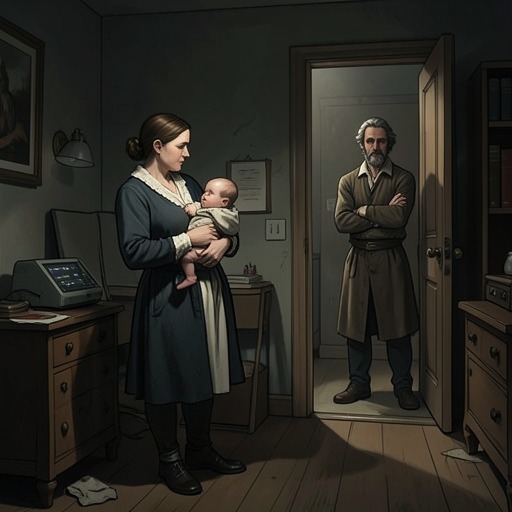
Coralie
And Their Children After ThemCoralie is Hacine Bouali’s partner, the force behind the home they build together, and the mother of their daughter, Océane. Her cheerfulness and practical care help make an ordinary life seem possible to Hacine, whose alienation and old anger remain difficult to contain. But the security she helps create is not an uncomplicated resolution: work, money, parenthood, and Hacine’s impulsiveness gradually turn their shared life into a source of friction as well as refuge.
Identity and Introduction
When the narrative looks in on the couple during a quiet morning, Hacine and Coralie have been together for nearly eighteen months and have shared an apartment since spring. Coralie had insisted on living together. Their first meeting took place at Derch, where Hacine was completely drunk; two months later, he was having lunch with her parents. The quick movement from an uncertain first encounter to family introductions anticipates the decisive role she will play in drawing him into a settled domestic world.
Coralie has a technical diploma and a steady job at the prefecture. Her parents belong to the working world of the valley: her father does maintenance at a high school and is a union man, while her mother works at Solin, the area’s last silk mill. At the first family lunch, her mother has prepared fish and her father brings out Bordeaux, which Hacine drinks without hesitation. The visit gives their relationship an ordinary, welcoming frame, quite different from the unsettled existence Hacine had known while living at his father’s place.
Building a Shared Life
For Hacine, the relationship makes little sense on paper, but its value is practical and emotional. His work with Solodia is physically demanding and repetitive, and he feels that his time and body belong to other people’s rules. Coralie helps make the rest of life bearable: household purchases offset the strain of work, the prospect of a vacation offers something to anticipate, and her company interrupts the week’s monotony. Friends, weed, television, and video games also remain part of his small routine, but Coralie is the person who makes that routine feel like a life rather than mere endurance.
Her influence is visible in the apartment itself. When Coralie leaves for three days of training, the home becomes a mess and, in Hacine’s perception, nearly a cave; when she returns to it, her activity makes the rooms feel cleaner and brighter. On their last day together before work resumes, she decides what they will do. While she dresses, Hacine prepares sandwiches, packs a blanket, and fills a cooler. They go to the shore of Le Perdu Lake, find shade, and stretch out together. The modest arrangement—food, a blanket, a day away—shows how their relationship gives shape to leisure as well as to domestic routine.
Coralie also offers companionship against a more painful absence. After Hacine loses his teeth in the violent episode at L’Usine and faces the aftermath of the trial, his father cares for him and later returns to Morocco for good. Hacine now hears his father as a stranger over the telephone and fears that a visit would mean confronting someone who has become almost a ghost to him. The account presents Coralie’s intimacy as help against that loneliness, not as a cure for it. Hacine has been promising himself to visit his father for months, and his fear remains.
Security and Unease
The couple’s relationship steadies Hacine without making him wholly comfortable in it. At a public gathering, he walks hand in hand with Coralie and their dog, privately planning to let go of her hand after they pass a refreshment stand but unable to do so. Seeing friends from earlier years, he feels the distance between his old habits and his present life. He has given up many of those habits, though he does not regret the change: Coralie means that his periods of gloom no longer leave him entirely alone with the feeling that his life has failed.
Yet Hacine experiences ordinary couplehood in public as if he has been cast in a part that does not fit. He imagines that intimacy has carried them through sleepovers, shared plans, and domestic adjustments into a life he no longer recognizes. The narrative makes clear that Coralie has not demanded that he abandon his friends; his old companions have even spent much of the night playing video games at their home. His discomfort therefore comes less from a specific restriction imposed by her than from his own difficulty inhabiting the role of a companion. He had imagined becoming a made man, and cannot reconcile that fantasy with the habits and compromises of a shared life.
Their economic circumstances sharpen the contrast between stability and limitation. Coralie wants French fries and a beer at the gathering, and Hacine pays while counting the money. He compares his monthly pay of 7,240 francs with the nearly 5,000 francs a weekend for two at the seawater therapy spa Coralie would like to visit. A salary initially reassures him after the unpredictability of business, but he comes to see that small earnings set the limits of what can be planned. Their life is made up of modest purchases and anticipated pleasures, and even a short break can feel prohibitively expensive. Coralie’s hope that the spa would do them good meets his sharper awareness of how long he must work to afford it.
Parenthood and Growing Strain
After Océane is born, the practical terms of the relationship change. Their days become a succession of night wakings, bottles, diapers, walks, and work. Hacine and Coralie argue, pass one another exhausted, and seem to him like partners maintaining a fragile enterprise. Océane is six months old in early August. Coralie is distressed by the twenty-five pounds she has not lost since pregnancy and often bursts into tears; Hacine’s attempts to put the change in perspective make matters worse. Their sexual relationship has stopped, another sign that the closeness of their earlier life has been displaced by exhaustion and care.
Coralie’s parents are now deeply involved in the couple’s household. They visit without warning to see the baby and help, bringing soup and supplies; Coralie’s mother leaves an apron and cleaning products, assists with housework, and reorganizes the kitchen drawers. Hacine recognizes that they have adopted him and is grateful for their help, but experiences their habits and presence as an invasion. Their fixed meal times, careful accounting, and insistence on familiar principles intensify his sense of being a stowaway in a life that does not belong to him. The conflict is not simply that Coralie’s family is unkind: their care is real, and that very kindness makes it hard for Hacine to refuse their place in the household.
The birth of Océane also reveals a difference in how the couple experiences family life. Hacine has long loved Coralie’s sociability, appetite for fun, and enthusiasm for Christmas, when she takes pleasure in preparations, small gifts, and festive details. He sees her as someone for whom nearly everything is worth trying, while he tends to withdraw. After Océane arrives, he comes to understand that the child has filled a deep emptiness in Coralie’s life and become the measure by which she organizes everything. He does not describe himself as jealous of his daughter; rather, he feels that fatherhood has not displaced the neuroses and anger that were already there. The baby brings no automatic transformation for him, even as she becomes central to Coralie.
Ultimatum and Unresolved Crisis
The strain becomes concrete when Hacine buys a Suzuki DR 125 from a salesman at the store where he works. He writes the check without thinking, although the couple is already short of money, has no garage, and cannot afford a vacation that year. Coralie objects both to the cost and to the danger she associates with motorcycles. Her anger is set against the small, vulnerable domestic world around them: Océane is in her crib tearing pages from a La Redoute catalog, while Coralie, exhausted and near tears, has recently dyed her hair for the third time that month. The purchase is not merely a disputed expense; it brings Hacine’s old attachment to motorcycles into direct conflict with the responsibilities and fears of family life.
During their argument, Coralie pulls Hacine by the ear. Both stop when they realize that their noise might wake the baby, and Coralie waits until Océane remains asleep before speaking quietly. She tells Hacine that unless he changes course, she will pack, take their daughter, and prevent him from seeing them again. She then leaves him with Océane as he is about to go to work. Her mother arrives and calmly takes over the baby’s care, allowing Hacine to get ready.
The scene ends not with a resolution between the couple but with Hacine’s attention fixed on the child’s vulnerability. He kisses Océane before leaving on the motorcycle, while Coralie has taken the car. The fear he feels about the many ways a small child could be harmed makes the disagreement over motorcycling newly consequential: the issue touches not only money or maturity but the possibility of loss. The supplied episode does not establish whether Coralie carries out her threat or whether Hacine changes his behavior. It leaves their shared life at a threshold, with the ultimatum exposing how much the stability she built now depends on decisions he has not yet made.